
LPG highlighted as a practical pathway to accelerate decarbonisation in LR’s latest Fuel for thought report
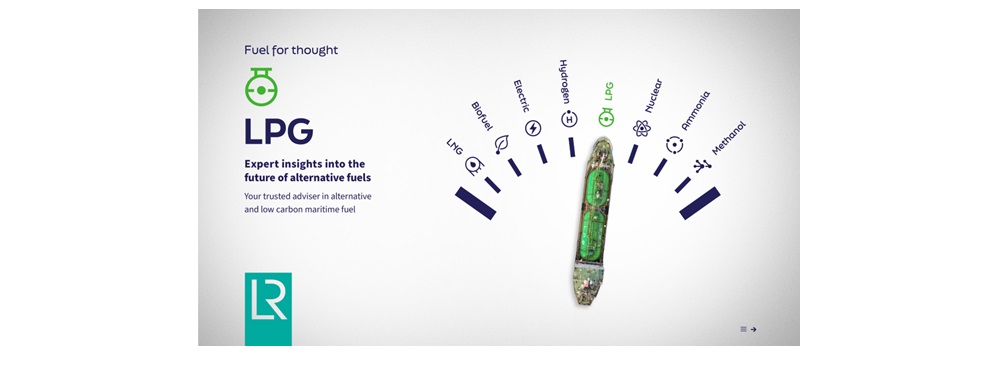
The updated edition of LR’s Fuel for Thought LPG report positions LPG as an immediately deployable, scalable and technically proven fuel pathway capable of delivering meaningful emissions reductions across the maritime sector.
Lloyd’s Register (LR) has published an updated edition of its Fuel for Thought: LPG report, produced jointly with the World Liquid Gas Association (WLGA), setting out how LPG can support the maritime sector’s transition to lower carbon propulsion with immediate, scalable impact.
With more than 1,600 LPG carriers already in operation and a mature global supply chain supported by over 1,000 storage facilities and terminals, LPG combines mature technology, global availability and established infrastructure with a practical and credible pathway to lower-emission shipping.
Fuel for thought: LPG shows how LPG can deliver meaningful environmental benefits compared with conventional marine fuels. Fossil LPG emits around 97% less sulphur oxides, 90% less particulate matter and approximately 20% less carbon dioxide than heavy fuel oil, while lifecycle greenhouse gas emissions can be reduced by up to 17% compared with marine gas oil.
The fuel’s lower carbon-to-hydrogen ratio also positions it as a viable route to improving compliance with measures such as EEXI, CII and regional regulation including EU ETS and FuelEU Maritime.
The updated report underscores that LPG is already proven in service. Dual-fuel LPG propulsion is well established in the gas carrier segment, with a growing LPG-fuelled fleet and strong orderbook. Furthermore, gas carriers currently account for only a small share of global shipping emissions, leaving significant potential for cross-segment adoption across container ships, bulk carriers and other vessel types.
Beyond its environmental performance, LPG presents a compelling commercial proposition for shipowners seeking cost-effective decarbonisation solutions. Lower capital expenditure compared to other alternative fuel solutions, combined with competitive fuel pricing in key regions, strengthens its appeal as a transitional fuel. Retrofit pathways are also more accessible, with a significant number of existing cross-segment ship types technically capable of conversion to LPG propulsion.
The report also highlights strong market fundamentals supporting wider uptake. Global seaborne LPG trade reached a record 145 million tonnes in 2025 and is expected to continue growing, supported by rising demand in major import markets and increasing fleet capacity. At the same time, around 500 global LPG terminals could potentially become LPG bunkering points for non-gas carriers as well with minimal new investment, helping to address one of the key barriers facing alternative fuel adoption.
Looking ahead, the report emphasises that LPG’s long-term role will be shaped by the growth of renewable production. Renewable LPG (rLPG) and bio-LPG are chemically identical to conventional LPG and can be used as drop-in fuels without modifications, offering up to 80% emissions reduction depending on feedstock. Industry projections suggest rLPG could meet up to 50% of global demand by 2050, creating a credible long-term pathway towards near-zero-emission shipping operations.
The report also highlights the potential to pair LPG with onboard carbon capture systems to further reduce emissions and extend vessel lifespans. Combining LPG propulsion with carbon capture could deliver significant cost benefits, including reduced carbon pricing exposure and lower onboard storage requirements due to already lower CO2 emissions.
However, barriers remain. The regulatory framework for LPG bunkering is still developing and engine options, particularly beyond two-stroke applications, are not yet fully mature. The report suggests that wider adoption will depend on how quickly these technical and regulatory gaps are addressed.
Constantinos Chaelis, Global Gas Segment Director, Lloyd’s Register, said: “Our latest Fuel for Thought: LPG report reinforces what our industry has long needed—an immediately deployable, commercially viable and technically proven cross-segment pathway to accelerate decarbonisation.
“With mature infrastructure, a growing dual‑fuel fleet and clear emissions advantages over conventional marine fuels, LPG offers shipowners a practical route to compliance and meaningful carbon reduction today. As renewable LPG scales and retrofit options expand, in consideration with onboard carbon capture, LPG stands out as a credible long‑term solution capable of supporting the sector’s transition toward lower, and ultimately near‑zero‑emission operations.”
Nikos Xydas, World Liquid Gas Association (WLGA) Technical Director, said: “LPG has become one of the most widely adopted alternative marine fuels globally in the gas carriers segment.
“Whether for the world’s largest ships or for the smallest outboard motors, LPG offers a low-carbon, low-emissions and cost-effective fuel today, and a credible long-term pathway in the future with drop-in renewable LPG and renewable dimethyl ether into existing fuel systems, for a future-ready solution.”
The Fuel for thought: LPG report can be downloaded
About Lloyd’s Register
Trusted maritime and energy sector advisors, partnering with clients to drive performance across the ocean economy.
Lloyd’s Register (LR) is a global professional services group specialising in marine and offshore engineering, technology and digital solutions. We were created more than 260 years ago as the world’s first marine classification society to improve and set standards for the safety of ships.
Today we are a leading provider of classification and compliance services to the marine and offshore industries, helping our clients design, construct and operate their assets to accepted levels of safety and environmental compliance.
We also provide advisory services and digital solutions, supporting fleet and voyage performance and optimisation. Through OneOcean, LR delivers integrated digital solutions supporting voyage planning, optimisation, compliance, training and fleet performance across more than 30,000 vessels globally.
In the race to zero emissions, our research, advisory and technical expertise and industry-firsts are supporting a safe, sustainable maritime energy transition.
Lloyd’s Register Group is wholly owned by the Lloyd’s Register Foundation, a politically and financially independent global charity that promotes safety and education.
For more information, go to www.lr.org
About World Liquid Gas Association (WLGA)
The World Liquid Gas Association is the authoritative voice for the global Liquid Gas industry, representing the full Liquid Gas value chain. The primary goal of the association is to add value to the sector by driving premium demand for Liquid Gas, while also promoting compliance to good business and safety practices. With over 300 members in 125 countries, the association brings together private and public companies involved in one, several or all activities of the industry, develops long-term partnerships with international organisations, and implements projects on local and global scales. The association was established in 1987 and granted Special Consultative Status with the United Nations Economic and Social Council in 1989.
