
New report calls for standardised approach to Safe Havens on ammonia-fuelled ships
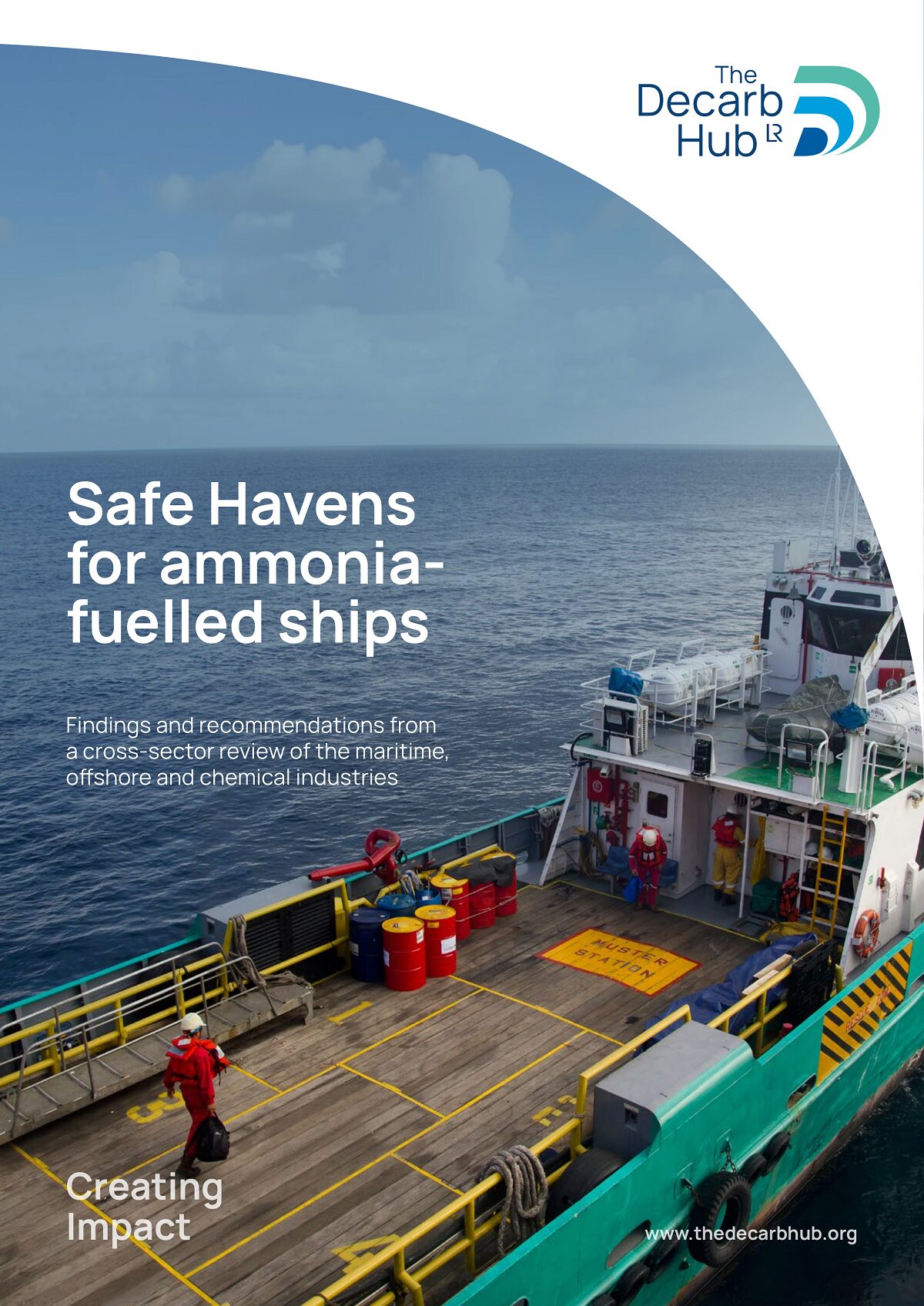
The report identifies an opportunity to build a shared, evidence-based approach to Safe Havens as the industry applies new regulatory requirements to ammonia-fuelled vessels.
Lloyd’s Register Maritime Decarbonisation Hub (The Decarb Hub) has called for a standardised approach to the design and assessment of Safe Havens on ammonia-fuelled vessels, highlighting that inconsistent interpretations of emerging regulatory requirements could result in differing safety outcomes across the future ammonia fleet.
This is set out in a new report, ‘Safe Havens for ammonia-fuelled ships’, which examines how the maritime sector can apply lessons from offshore oil and gas, chemical processing and other safety-critical industries to address a new requirement introduced under the International Maritime Organization’s (IMO) Interim Guidelines for the Safety of Ships using Ammonia as Fuel. The new guidelines now require vessels to incorporate Safe Havens to protect crew in the event of an ammonia release.
However, the report highlights that, as is often the case with interim, goal-based guidance for a new safety concept, the guidelines set high-level requirements that leave room for differing interpretations of what makes an effective Safe Haven. It proposes a shared framework to help vessel designers, operators, classification societies and flag administrations apply these requirements consistently as ammonia-fuelled vessels enter service.
The Decarb’s Hub research found that Safe Havens should not be viewed as standalone spaces designed solely to prevent ammonia exposure. Instead, they should be treated as human-centred systems that form part of a vessel’s wider emergency response strategy.
The report identifies three core functions that every maritime Safe Haven should provide: protection, command and control, and accessibility. Together they are intended to ensure that all crew remain protected from ammonia and other hazards, while enabling the execution of the vessel’s emergency response plan.
Drawing on established practices from industries that routinely manage toxic gas hazards, the report recommends that Safe Haven performance is assessed against realistic worst-case scenarios. It also highlights the importance of calculating Safe Haven endurance periods, assessing accessibility, regular testing and maintenance and human factors considerations to ensure systems continue to perform as intended throughout a vessel’s operational life.
The report concludes that the industry should focus on developing standardised methods for demonstrating Safe Haven performance. Establishing a consistent basis for assessment will help ensure Safe Havens deliver the intended level of protection across the future ammonia-fuelled fleet while supporting regulatory certainty and long-term operational confidence.
Jonathan Bolton, Decarbonisation Risk Analyst at the Lloyd’s Register Maritime Decarbonisation Hub, said: “Ammonia has the potential to play an important role in shipping’s decarbonisation journey, but its adoption must be supported by safety solutions that are robust, practical and consistently applied. Safe Havens are a new requirement for ammonia-fuelled ships and as with any new safety concept, the industry needs practical guidance to build a shared understanding of how Safe Havens should be designed and assessed.
Our report brings together decades of experience from industries that have long managed toxic gas risks and translates those lessons into a maritime context. By identifying the critical functions that Safe Havens must perform and proposing a common framework for their assessment, we hope to support designers, operators, classification societies and regulators as they work towards the safe deployment of ammonia-fuelled vessels.”
The findings are intended to support shipowners, designers, regulators and classification societies as they develop the first generation of ammonia-fuelled vessels and contribute to the long-term evolution of international regulations governing ammonia safety.
A copy of the report can be downloaded at Safe Havens for ammonia-fuelled ships | The Decarb Hub
About The Decarb Hub
The Lloyd’s Register Maritime Decarbonisation Hub (commonly known as The Decarb Hub) is an independent, non-profit initiative established through a partnership between Lloyd’s Register Foundation — a global charity with a mission to engineer a safer world — and Lloyd’s Register Group, a global provider of maritime professional services with over 260 years of heritage.
This partnership brings together the Foundation’s public benefit mandate and focus on societal resilience, with the Group’s deep technical expertise and trusted relationships across the maritime industry.
Positioned at the intersection of these two organisations, the Hub is uniquely equipped to accelerate the safe, sustainable, and human-centric decarbonisation of global shipping — combining neutrality with influence, and research with real-world application. For more information, go to www.thedecarbhub.org
About Lloyd’s Register
Lloyd’s Register (LR) is a global professional services group specialising in marine and offshore engineering, technology and digital solutions. We were created more than 260 years ago as the world’s first marine classification society to improve and set standards for the safety of ships.
Today we are a leading provider of classification and compliance services to the marine and offshore industries, helping our clients design, construct and operate their assets to accepted levels of safety and environmental compliance.
We also provide advisory services and digital solutions, supporting fleet and voyage performance and optimisation.
Our digital solutions are relied upon by more than 30,000 vessels, following the acquisition of OneOcean in 2022 and Ocean Technologies Group in 2024.
In the race to zero emissions, our research, advisory and technical expertise and industry-firsts are supporting a safe, sustainable maritime energy transition.
Lloyd’s Register Group is wholly owned by the Lloyd’s Register Foundation, a politically and financially independent global charity that promotes safety and education.
For more information, go to www.lr.org
About Lloyd’s Register Foundation
Lloyd’s Register Foundation is an independent global charity that supports research, innovation, and education to make the world a safer place. Its mission is to use the best evidence and insight to help the global community focus on tackling the world’s most pressing safety and risk challenges. For more information, please visit www.lrfoundation.org.uk
