
Maritime transport statistics – short sea shipping of goods
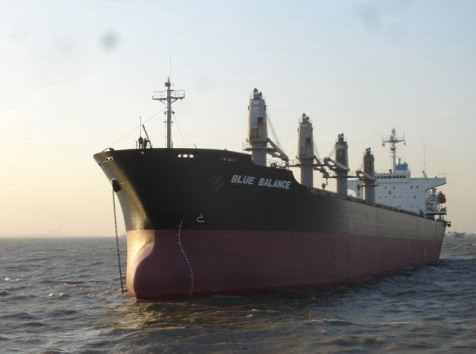 This article presents recentshort sea shippingstatistics of theEuropean Union (EU), covering the transport of goods betweenportsin theEU-28on the one hand, and ports situated in geographical Europe, on the Mediterranean and the Black Sea on the other hand. Data is also available for Iceland (for some years), Norway and Turkey. The results are broken down by sea regions (Atlantic Ocean, Baltic Sea, etc.) and by type of cargo. The figures presented are for maritime transport of goods reported bymain ports.
Main statistical findings
In 2013, the short sea shipping (SSS) in the EU-28 was above 1.7 billion tonnes of freight. Short sea shipping volumes in the main ports of the United Kingdom (UK) came close to 307 million tonnes of cargo in 2013, accounting for 14\% of the total tonnages of short sea shipping in the EU-28 countries. The UK was followed by Italy and the Netherlands, with shares of 12.4\% and 12\% of the EU short sea shipping total, respectively.
Short sea shipping made up 58\% of total EU-28 maritime transport of goods in 2013, about the same as in 2012. However, the share of short sea shipping in total maritime transport varies considerably between the reporting countries. The predominance of short sea shipping of goods overdeep sea shippingwas particularly pronounced (above 80\%) in Bulgaria, Denmark, Ireland, Croatia, Cyprus, Latvia, Malta, Poland, Finland and Sweden, as well as in the EEA country Norway.
Geographical considerations, such as long coast lines and a large number of inhabited islands, will play a part in explaining the high share of short sea shipping in most of these countries. A large volume offeeder servicesto or fromhub portswill also explain the high degree of short sea shipping transport in countries which function as regional transhipment points, such as Malta. In contrast, the share of short sea shipping is lower than 60\% in countries with major ports concentrating on intercontinental trade (such as Belgium, Germany, Spain, France, the Netherlands, Portugal and Slovenia).
Short sea shipping by sea region and countryShort sea shipping of goods between main EU-28 ports and ports located in the Mediterranean was 570 million tonnes in 2013. This accounted for about 29\% of the total short sea shipping tonnages declared by the main EU-28 ports. Short sea shipping with the North Sea and the Baltic Sea followed, with 498 and 430 million tonnes, respectively (25\% and 22\% of the total).
For most countries, the highest share of their short sea shipping of goods was with partner ports located in the same sea region as their own coastline. There are some exceptions, like Latvia, where about half of the short sea shipping of goods came from or was destined to ports located in the North Sea. Romania and the Netherlands are two other exceptions. The largest share of short sea shipping was the Mediterranean for Romania and the Baltic Sea for the Netherlands.
The total tonnage of short sea shipping in main EU ports declined 1.8\% from 2012 to 2013, indicating a slight reverse in the gradual recovery seen in European short sea shipping in the years following the economic downturn in Europe in 2009. Inevitably, the 2013 level of European short sea shipping remained below the figures recorded 7 years earlier, in 2005.
France recorded the largest fall in short sea shipping of goods in 2013 (-19\%), followed by Malta (-10\%) and Latvia (-8\%). However, the 2012 and 2013 figures for France have been partially estimated by Eurostat. In consequence, the substantial decrease in the French short sea shipping tonnages for 2012 and 2013 may largely reflect the deficiencies in the data quality (see methodological notes). In contrast, the substantial increase observed in the short sea shipping tonnages for Cyprus from 2005 to 2013 may be a reflection of an improvement in data quality.
Transport by type of cargoIn 2013, liquid bulk at 782 million tonnes accounted for close to 45\% of total short sea shipping of goods to and from EU-28 ports, followed by dry bulk at 341 million tonnes (20\%), containers at 249 million tonnes (14\%) andRoll on – roll off (Ro-Ro)units at 235 million tonnes (13\%).
For liquid bulk, the Netherlands had the largest volume of short sea shipping in 2013 (148 million tonnes), followed by Italy (133 million tonnes) and the UK (119 million tonnes). The UK led the EU-28 rankings for short sea shipping of dry bulk goods in (with 64 million tonnes) and for goods shipped on Ro-Ro units (84 million tonnes). At 49 million tonnes, Germany was the main country in terms of short sea shipping of containers, followed by Belgium at 42 million tonnes and Spain at 41 million tonnes.
As in previous years, liquid bulk remained the largest cargo type in all sea regions in 2013. However, while liquid bulk goods accounted for almost two thirds of total short sea shipping of goods in the Black Sea, the comparable figure for the Atlantic Ocean was a little over one third of the total. The share of dry bulk goods also displays variation between the sea regions, with a range from 15\% in the Mediterranean to 24\% in the Baltic. At 21\%, the Mediterranean had the largest share of short sea shipping of containers in 2013, while the Atlantic Ocean (where the two main Ro-Ro ports, Dover and Calais, are located) had the largest share of short sea shipping of goods on Ro-Ro units (21\%).
Top EU-28 portsThe top 20 ports accounted for 36\% of the total short sea shipping of goods in the EU in 2013. Rotterdam in the Netherlands remained the largest EU port for short sea shipping, with a total of 188 million tonnes shipped in 2013. Among the other top three ports in terms of short sea shipping of goods, Antwerpen in Belgium handled 90 million tonnes of short shipped goods in 2013 and Hamburg in Germany handled 50 million tonnes.
Except for the main deep sea hub ports – Rotterdam, Antwerpen, Hamburg, Amsterdam in the Netherlands, Le Havre in France and Algeciras and Valencia in Spain – most of the other top 20 ports had shares of short sea shipping in total seaborne transport of goods well above 60\%.
At 117 million tonnes, Rotterdam accounted for 12\% of total short sea shipping of liquid bulk declared by the main EU-28 ports in 2013, by far the largest volumes of short sea shipping of liquid bulk goods for any EU port. At 18 million tonnes, Riga in Latvia confirmed its position as the largest port for short sea shipping of dry bulk goods in Europe, followed by Amsterdam at 16 million tonnes.
Short sea shipping of containersUnlike dry bulk, the market for ports handling short sea shipping of containers is concentrated around the hub ports, with the top 5 ports accounted for 39\% of the total short sea shipping of containers in the main EU-28 ports in 2013. Antwerpen remained the largest EU port for short sea shipping of containers in 2013, with a share of 11\% of the total tonnages of goods shipped in containers. Antwerpen was followed by Rotterdam, Hamburg, Piraeus and Bremerhaven, all handling more than 20 million tonnes of goods shipped in containers over short sea distances.
Overall, however, deep sea shipping of goods in containers has a larger volume in terms of tonnages in the main EU-28 ports than short sea shipping of goods in containers. In contrast, shipping of goods on Ro-Ro units is almost exclusively short sea, with Dover and Calais on each side of the Channel handling the largest tonnages of Ro-Ro goods (at 25 million tonnes and 15 million tonnes, respectively).
In terms of number of twenty-foot equivalent units(TEUs), movements of containers in short sea shipping in EU-28 ports increased by 3\% from 2012 to 2013 (to nearly 29 million TEUs). Greece, Poland, Portugal, Romania and Slovenia all reported growth rates of more than 13\% in short sea shipping of TEUs compared with 2012, while Croatia reported a considerable decrease in the number of TEUs in relative terms (-17\%).The 2012 and 2013 figures for France have been partially estimated by Eurostat and the decrease in the number of short sea shipped TEUs may largely reflect the deficiencies the in data quality (see methodological notes). Similarly, the increase in number of TEUs observed for Cyprus between 2010 and 2011 may reflect an improvement in data quality.
Data sources and availabilityShort sea shipping (SSS), as covered in this article, deals with the transport of goods between ports in the EU-28 Member States on one hand, and ports situated in geographical Europe or in non-European countries with coastlines on the Mediterranean and the Black Sea on the other, i.e. ports in the 23 maritimeEU Member States(Belgium, Bulgaria, Denmark, Germany, Estonia, Ireland, Greece, Spain, France, Croatia, Italy, Cyprus, Latvia, Lithuania, Malta, the Netherlands, Poland, Portugal, Romania, Slovenia, Finland, Sweden and the United Kingdom), in the two maritimeEEAcountries (Iceland and Norway), in the twocandidate countries(Montenegro and Turkey) and in the remaining countries on the Baltic (Russia), on the Mediterranean (Albania, Algeria, Bosnia–Herzegovina, Egypt, Israel, Lebanon, Libya, Morocco, Occupied Palestinian territories, Syria, and Tunisia) and on the Black Sea (Georgia, Moldova, Russia and Ukraine).
This definition is derived from the Communication of the Commission COM (1999) 317 final of 29.06.1999 on the development of SSS in Europe (page 2). As a result, SSS includes “feeder services “: a short sea network between ports in order for the freight to be consolidated or redistributed to or from a deep sea service in one of these ports (“hub ports”). The category “other seaborne transport” includes “deep sea shipping” and transport with unidentified partner ports (“unknown ports”).
The content of this article is based on data collected within the framework of the EU maritime transport statistics Directive, i.e.Directive 2009/42/ECof 6 May 2009 on statistical returns in respect of carriage of goods and passengers by sea, which is a recast of the originalCouncil Directive 95/64/ECof 8 December 1995.
The results shown are calculated on the basis of dataset A1 for most of the tables and graphs and dataset C1 for the statistics on number of TEUs. This data is mainly collected for main ports , which are defined as ports handling more than 1 million tonnes of goods annually.
Data are collected at level ofstatistical ports. In some countries, the sometimes numerous very small ports are grouped for practical statistical reasons under a notional statistical port (“other ports”).
“Gross weightof goods” means the tonnage of goods carried, including packaging but excluding the tare weight of containers or Ro-Ro units. Ro-Ro units as presented in this article include both “self-propelled roll-on/roll-off units” and “non-self-propelled roll-on/roll-off units”.
The following sea regions have been taken into account to group the SSS partner ports: the Baltic, the North Sea, the Atlantic Ocean (including the English Channel and the Irish Sea), the Mediterranean and the Black Sea. Ports located in Morocco–West Africa, Egypt–Red Sea, Israel–Red Sea and Russia–Barents and White Seas are not part of the European SSS.
1. The Baltic:
- Danish ports below the Helsingborg–Korsør–Nyborg–Kolding line (including Helsingor).
- All ports of Finland, Estonia, Latvia, Lithuania and Poland as well as German and Russian ports on the Baltic.
- The Swedish ports on the Baltic from Helsingborg (included).
2. The North Sea:
- All ports of Norway, the Netherlands and Belgium as well as the ports of Germany on the North Sea.
- Swedish ports on the North Sea from Helsingborg (excluded).
- Danish ports on north of the Helsingborg–Korsor–Nyborg–Kolding line and North Denmark (excluding Helsingor). Faroe Islands.
- United Kingdom: ports on the east coast of Great Britain from Ramsgate (included) to Cape Wrath in Scotland, the Shetland Islands and Orkney Islands.
3. The Atlantic Ocean:
- United Kingdom: ports of Great Britain on the Channel (from Ramsgate excluded) and the west coast to Cape Wrath in Scotland; ports in Northern Ireland.
- All ports of Ireland, Portugal (including Açores and Madeira) and Iceland.
- French ports on the Atlantic Ocean and on the Channel, up to the Belgian border.
- Spanish ports on the Atlantic Ocean to Tarifa (included); Canary Islands are included.
4. The Mediterranean:
- Spanish ports on the Mediterranean from Tarifa (excluded).
- French ports on the Mediterranean.
- All ports of Malta, Italy, Slovenia, Croatia, Bosnia-Herzegovina, Montenegro, Albania, Greece, Cyprus, Syria, Lebanon, Occupied Palestinian territory, Libya, Tunisia, Algeria and Gibraltar.
- Ports of Morocco, Egypt and Israel on the Mediterranean.
- Ports of Turkey on the Mediterranean (including the ports on the Bosporus).
5. The Black Sea:
- All Black Sea ports excluding the ports on the Bosporus.
6. Others:
- Non-identified ports of Denmark, Germany, Spain, France, the United Kingdom, Israel, Morocco, Russia, Sweden, Turkey and Egypt; river ports of EU countries.
Other seaborne transportincludes “deep sea shipping” and transport with unidentified partner ports (“unknown”) – see specific notes for Cyprus and Romania.
EU-28figures refer to a total of 23 Member States. The 5 landlocked EU Member States (Czech Republic, Luxembourg, Hungary, Austria and Slovakia) do not have seaports
Country-specific remarksNo specific remarks for Belgium (BE), Bulgaria (BG), Denmark (DK), Estonia (EE), Greece (EL), Latvia (LV), Poland (PL), Slovenia (SI), Finland (FI), Croatia (HR), Norway (NO) and Turkey (TR).
Germany (DE)Starting from 2013, the figures for Germany include data for all national ports (both main ports and minor ports)
Ireland (IE)Detailed data to be used for this publication (datasets A1 and C1) are available for Rosslare starting from 2009. In 2008, this port accounted for approximately 5\% of the total tonnage handled in Irish ports.
Spain (ES)Data include Ceuta and Melilla. Starting from 2011, the figures for Spain include data for a number of regional ports outside the state-controlled port system.
France (FR)Taking into account the definition of SSS, data do not include the French overseas territories (Départements d’Outre Mer/Collectivités d’Outre Mer). The quarterly data for port activity in France have been partially estimated by Eurostat for the period 2009-2013. They are to be considered as provisional and are likely to be revised. In general, these estimates reduce the accuracy of the statistics at a detailed level. In consequence, the data for France contain a significant share of declarations to and from unknown ports in 2012 and 2013: 22\% in 2013 and 8\% in 2012. The share is lower than 5\% for the previous years. For container statistics (table 9), the share of “unknown locations” was significant in 2010 and 2011 (5\% and 4\%, respectively), while it was close to nil in the other years, except for 2013 (2\%).
Italy (IT)In 2005, data collection methods were partly modified. Data for 2009 for some Italian ports have a better coverage than in previous periods, due to a change in data checking and compilation, including the integration of additional results, based also on the use of supplementary sources of information; and to the gradual introduction of a new methodology in data collection. In addition, data for some ports (for ex. Napoli and Brindisi) are underestimated for the 4th quarter 2008.
Cyprus (CY)The data reported by Cyprus contain a significant share of declarations to and from unknown ports until 2011 (28\% in 2011, 58\% in 2010, 61\% in 2009, 60\% in 2008, 59\% in 2007, 68\% in 2006, 44\% in 2005 and 63\% in 2004). In 2012 and 2013, the share is only of 2\% and 1\%, respectively. This has several consequences: the volume of SSS and its share in total seaborne transport are probably underestimated in the earlier years; growth rates of SSS between consecutive years may not be reliable. The same is also applicable to container statistics (table 9), where the share of “unknown locations” is 22\% in 2011, 64\% in 2010, 68\% in 2009, 66\% in 2008, 67\% in 2007, 61\% in 2006, 58\% in 2005 and 23\% in 2004. This share felt to 7\% in 2012 and 2013.
Lithuania (LT)No national maritime data reported.
Malta (MT)No national maritime data reported.
Netherlands (NL)No national maritime data reported until 2010. Starting from 2013, the quarterly figures for the port of Amsterdam include data for the port of Velsen. For container statistics (table 9), the share of “unknown locations” was significant starting from 2011: 12\% in 2011, 33\% in 2012 and 38\% in 2013. This has several consequences: the number of TEUs in SSS and its share in total seaborne transport are probably underestimated; growth rates of TEUs in SSS between consecutive years may not be reliable.
Portugal (PT)Data include Açores and Madeira. The data reported by Portugal contain a significant share of declarations to and from unknown ports in 2009 (13\%), while this percentage close to nil in previous years. This has several consequences: the volume of SSS and its share in total seaborne transport are probably underestimated, growth rates of SSS between consecutives years may not be reliable.
Romania (RO)The data reported by Romania contain a significant share of declarations to and from unknown ports: 5\% in 2013, 6\% in 2010, 2011 and 2012, 7\% in 2009, 13\% in 2008, 27\% in 2007, 21\% in 2006, 15\% in 2005 and 10\% in 2004. This has several consequences: the volume of SSS and its share in total seaborne transport are probably underestimated in the earlier years; growth rates of SSS between consecutive years may not be reliable. In particular the decrease between 2008 and 2009 is probably underestimated. The same is more specifically applicable to container statistics (table 9), where the share of “unknown locations” is 39\% in 2013, 51\% in 2011 and 2012, 50\% in 2010, 46\% in 2009, 53\% in 2008, 95\% in 2007, 84\% in 2006, 73\% in 2005 and 58\% in 2004.
Sweden (SE)Starting from 2013, the figures for Sweden include data for all national ports (both main ports and minor ports)
United Kingdom (UK)Port installations located on the Tees estuary report as ‘Tees & Hartlepool’. Both are located on the east coast (North Sea) of the United Kingdom. Forth refers to port installations located in the Firth of Forth, close to Edinburgh.
Other issues
All the results shown in this publication are calculated on the basis of the statistics declared by main ports vis-à-vis their partner ports.
In order to estimate the transport of goods by sea (between ports), the problem of “double counting” (the transport of the same cargo of goods is declared by both the port of loading – as outwards – and the port of unloading – as inwards) has to be addressed.
Where both the port of loading and the port of unloading provided data, only the incoming goods declared by ports were added together to determine the total transport on the maritime route in question (“elimination of double counting“). The algorithm for the elimination of double counting is applied at statistical port level.
The totalSSS per countryexcludes the double counting of national transport declarations. The totalSSS for the EU-28excludes the double counting of national and international intra-EU transport declarations. The aggregates (“total”) per country may therefore differ from the sum of inwards and outwards declarations. The aggregates for the EU-28 may therefore differ from the sum of inwards and outwards declarations and also from the sum of the countries’ figures.
For this reason, for example in Table 1, the figures for EU-28 may differ from the sum of the countries’ figures. As a consequence, in order to estimate the share of each country in the total EU-28 SSS, the sum of the countries’ figures is used as denominator (instead of the figure for the EU-28 aggregate).
Figure 1: The “other seaborne transport” includes the data for which the ports of loading or unloading are unknown. It should be noticed that in 2013 the share of unknown partner ports in the total seaborne transport is less than 5\% for all countries except France (22\%), the EU-28 average being 2.7\%.
Table 1: In this table double counting has been treated also at sea region level. Where both the port of origin and the port of destination provided data, and where both ports belong to the same country and the same sea region, only the incoming goods declared by each were added. For this reason the total obtained in Table 1 by adding the figures for sea regions at country level may differ from the “total” shown in the last column (where double counting has been treated only at country level). The same applies at EU level. As a consequence the percentages shown inFigure 2are calculated using as denominator the sum of the figures for sea regions at EU-28 level as shown in Table 1 (instead of the “total” for the EU-28).
Figure 3 and Table 3: “Other cargo” also includes “type of cargo unknown”.
Tables 4 to 8: The “other seaborne transport” includes the data for which the ports of loading or unloading are unknown. It should be noted that in 2013 the share of unknown partner ports in the total seaborne transport is less than 4\% for all the mentioned ports, except Le Havre (7\%) and Milford Haven (5.4\%). The “Total EU-28 ports” aggregate is simply the sum of inwards and outwards declarations of individual ports (no elimination of double counting), except transport movements within the same statistical port.
Special symbols used in the tables
- “:” Not available
- Mio Million
Somestructural changesin data collection implemented in 2006 may have an impact on the comparability of databetween 2005 and 2006.
In 2006, data concerning transport to/from Russian ports located on the Barents and White Seas started being collected separately. Transport to/from these ports is not included in the definition of SSS. In 2005 (and previous years), in some cases, these data had probably been included in Russian maritime coastal areas, which are part of the definition of SSS. The impact of this structural change would be an under estimation of the SSS growth rates between 2005 and 2006, that could be roughly estimated as follows: BE 1.3, DE 0.3, NL 3.0, EU-28 0.5 percentage points. This means that, if the assumptions and estimates above are correct, for example, the growth rate for the EU-28 SSS would be about +2.0\% (instead of +1.5\%) between 2005 and 2006.
This structural change has been applied by France only in 2007 and may imply an under estimation of the SSS growth ratesbetween 2006 and 2007, that could be roughly estimated as follows: FR 0.6 and EU-28 0.1 percentage point. This means that, if the assumptions and estimates above are correct, for example the growth rate of SSS between 2006 and 2007 would be about +0.1\% (instead of -0.5\%, as shown in Table 2) for FR and +1.8\% (instead of +1.7\%) for EU-28.
Eurostat is the source of all the figures included in this publication. The figures reflect thedata availablein Eurostat’s reference database as ofApril 2015.
