
Brave Maritime buys throw spotlight on Greek hunger for handysizes
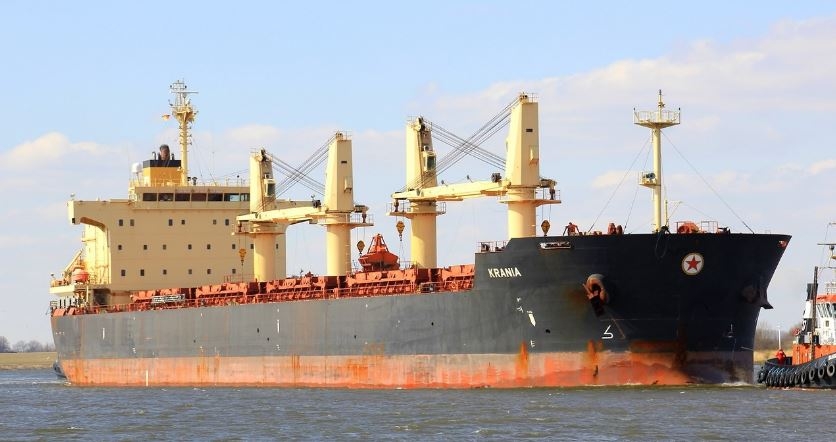
Country’s owners have been quick to jump on smaller bulkers amid rising freight rates and low orderbooks
Brave Maritime’s purchase of up to four Japanese handysizes has built on a groundswell of Greek shipowners buying in that class.
On 5 February, the company said it had agreed to buy the quartet for $56m in total. The vessels, which it did not identify, were built between 2012 and 2015.
Handysizes have been the single most popular vessel class for Greeks, accounting for nearly 60 out of about 180 bulkers they are known or reported to have acquired since early 2020.
All but one are between six and 18 years old. More than half were built in Japan, providing ample evidence of Greek owners’ esteem for tonnage built there.
Consistent Greek handysize buying began last May, as the world was emerging from the first wave of the coronavirus pandemic.
The deal flow accelerated in June and July, sputtered in August and September and came back with a vengeance in October — the busiest month, in which 10 handysizes were sold to Greek owners.
Greeks were not alone, but they were, as usual, among the first movers.
Come 2021, buyers from other countries caught on to the trend. More than one-third of all dry bulk transactions in the sale-and-purchase market in January concerned handysizes, Seaborne Shipbrokers said in a report.
“Being a much less capital-intensive asset when compared to the bigger dry bulk sizes, the increased appetite for handies is not a surprise amidst a market that has proven to be extremely volatile this year,” said Eva Tzima, head of research & valuations at the Athens brokerage.
Risk aversion
Risk aversion was not the only factor, according to Tzima. Handysizes benefited from post-pandemic market dynamics as well.
Prompted by food security concerns, populous countries such as China restocked on grains, which account for one-third of all cargo carried on such ships.
Ship supply dynamics were equally favourable. Seaborne estimated the newbuilding orderbook for such ships to be one of the lowest in the dry bulk sector, accounting for slightly more than 4% of the existing fleet on the water.
Conditions might improve even further, considering that about 15% of the handysize fleet on the water is older than 20 years and are thus potential demo candidates.
Less volatile
As a result, the Baltic index for handysizes rose by 46% in 2020 and has gained a further 8% this year. Shipowners like those increases, especially because they tend to be much less volatile than for panamaxes or capesizes.
“Even when markets drop, handysize freight rates fall much less abruptly than those for bigger ships,” one Greek owner told TradeWinds, explaining his rationale for buying such a vessel.
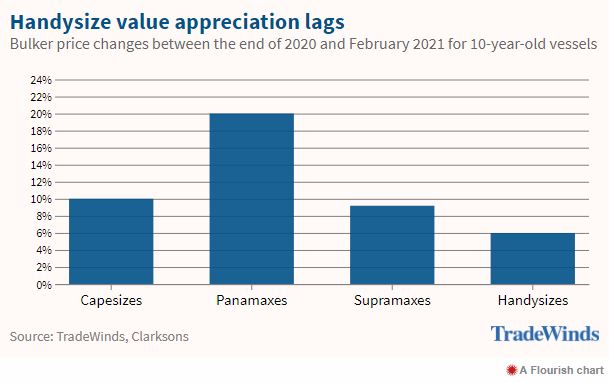
Freight earnings growth far outpaced handysizes’ appreciation on the secondhand market.
“Handies have managed to prove very resilient to the ups and downs in the freight market and have somehow managed to remain attractively priced,” Tzima wrote.
It is small wonder that Greek owners were attracted.
Brave Maritime’s move was its first in that sector for more than five years.
Kast Shipmanagement, a new company, made its market debut with the purchase of the 35,100-dwt bulker New Everest (built 2009), which has been renamed Everest K. The company is understood to have added a second vessel.
Piraeus-based Samios Shipping was one of the earliest players to move last May, when it bought the 35,200-dwt Asia Pearl III and Asia Pearl IV (both built 2010). The company has now been tied to a deal for the sistership Asia Pearl VI (built 2011) for about $6.2m.
Another early mover, little-known Pontos Marine, more than doubled its fleet with the purchase of three handysizes last summer.
Erasmus Shipinvest also acquired a trio of handysizes between May and July. Chief executive John Su said his company was interested in “top-class sustainable Japanese ships”.
In one of the most conspicuous deals for such tonnage, Athens’ Tri Bulk Shipping emerged as manager of the 38,300-dwt NY Trader I and 37,100-dwt NY Trader II (both built 2014), which Japan’s Nisshin was reported to have sold in July in an en-bloc deal worth about $25.5m.(Copyright)
tradewindsnews.com
