
Independent study confirms LNG reduces shipping GHG emissions by up to 23%
Peer-reviewed well-to-wake study updates definitive figures for GHG emissions from LNG as a marine fuel
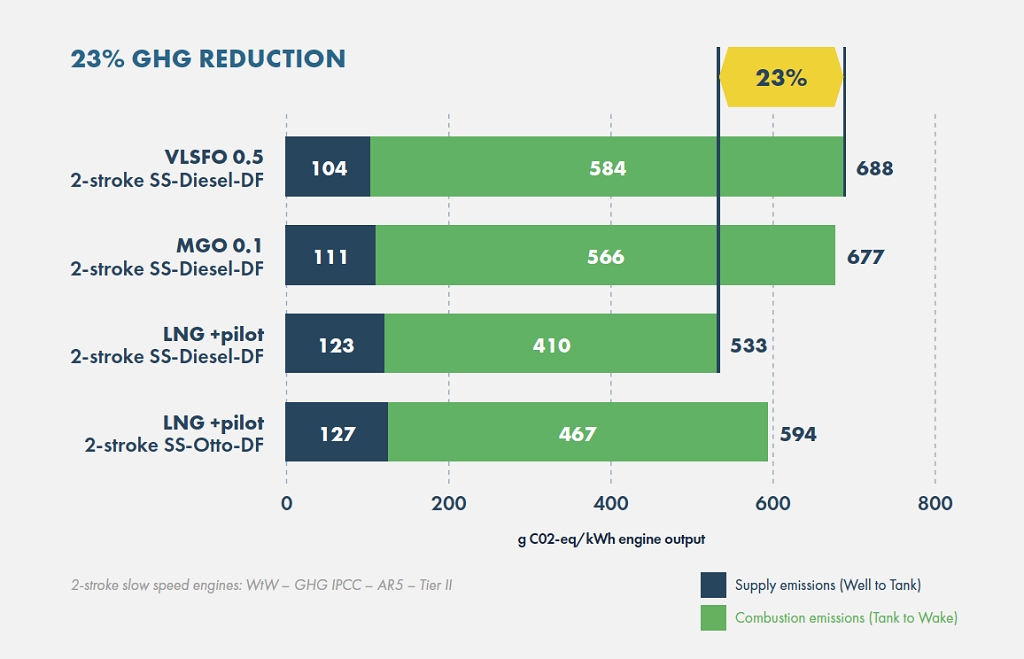
LONDON, UK – 16 April 2021: An independent study has reconfirmed that greenhouse gas (GHG) reductions of up to 23% are achievable now from using LNG as a marine fuel, depending on the marine technology employed. This is compared with the emissions of current oil-based marine fuels measured from Well-to-Wake (WtW). The 2nd Lifecycle GHG Emission Study on the use of LNG as a Marine Fuel from Sphera (formerly thinkstep) revisits its 2018/2019 research, using the latest available engine and supply chain data to bring the study fully up to date.
The study, commissioned by industry coalitions SEA-LNG and SGMF, was conducted according to ISO standards. It was also reviewed again by a panel of leading independent academic experts from key institutions in France, Germany, Japan and the USA. The analysis concluded that, in addition to the considerable air quality benefits it delivers, LNG can “beyond question” contribute significantly to the International Maritime Organisation’s (IMO) GHG reduction targets.
Commenting on the research, SEA-LNG Chairman Peter Keller said: “The updated Sphera study ensures that the industry has access to comprehensive research that is fully up to date. It is clear that LNG plays an important role in decarbonisation today with benefits available now. As we look ahead, it is essential that detailed emissions analysis from Well-to-Wake such as those performed for LNG are available for all alternative fuels contemplated, enabling shipowners to make the right decisions for their fleet.”
This comprehensive report uses the latest primary data to assess all major types of marine engines and global sources of supply with quality data provided by original equipment manufacturers including Caterpillar MaK, Caterpillar Solar Turbines, GE, MAN Energy Solutions, Rolls Royce (MTU), Wärtsilä, and Winterthur Gas & Diesel, as well as from ExxonMobil, Shell, and Total on the supply side. Methane emissions from the supply chains as well as methane released during the onboard combustion process (methane slip) have been included in the analysis.
Keller added: “Often based on outdated data, methane slip has become an overused argument for those wishing to justify inaction. The Sphera study underlines the advances being made to counteract this concern. Its analysis provides independent confirmation that, by 2030, methane slip will have been virtually eliminated as technological improvements continue. The facts consistently confirm that there is no deep-sea alternative fuel in the short to medium term other than LNG. LNG remains the clear starting point for a carbon-neutral future for shipping, especially as the pathway forward includes bio and synthetic products. Waiting is not an option. The industry must act now to capture the benefits that are clearly there for the taking by using LNG.”
Importantly, the study also reaffirms that the use of LNG as a marine fuel has significant air quality benefits, with local emissions, such as sulphur oxides (SOx), nitrogen oxides (NOx) and particulate matter (PM), all close to zero.
Samir Bailouni, chairman, Society for Gas as a Marine Fuel (SGMF), added: “It is important the industry has the best information to make often complex choices between fuels. This study provides authoritative, high-quality data on Well-to-Wake emissions for LNG.
“We are confident this work will provide IMO with solid information contributing to its regulatory decisions. SGMF will continue to provide up-to-date data not only for LNG but for all candidate gaseous fuels under its remit, including ammonia and hydrogen.
“Today, the clear choice for an immediate and significant reduction in emissions is LNG, which is widely available and fully compliant with existing regulations. This is reflected in the rapidly increasing adoption of LNG in the deep-sea container, bulk and tanker sectors, a trend we expect to accelerate even as the more challenging horizon fuels are brought safely and sustainably into the mix.”
Recognition for LNG and its pathway to a decarbonised future for shipping is accelerating. The transition to bio and eventually synthetic LNG is straightforward, as the existing infrastructure and engine technology remain the same. The standards, guidelines and operational protocols are already in place. It also provides an asset base that can be used by other alternative fuels, when and if they become commercially viable.
Dr Oliver Schuller, Director Sustainability Consulting, Sphera stated: “The aim of the study was to provide an update to the research conducted in 2018 / 2019. Using the latest available engine and supply chain data, including planned developments for the reduction of methane emissions along the entire supply chain, Sphera has analysed the implications for Well-to-Wake GHG emissions. Being conducted to international ISO standards and peer-reviewed by four genuine experts, we are confident that this represents the definitive view of lifecycle analysis for LNG as a marine fuel available today.”
About SEA-LNG
SEA-LNG is a UK-registered not for profit collaborative industry foundation serving the needs of its member organisations committed to furthering the use of LNG as an important, environmentally superior maritime fuel.
SEA-LNG has members across the entire LNG value chain including providers of the product, users, engine and asset suppliers, and class societies. SEA-LNG is already recognised as an international leader in LNG matters. Each member organisation commits mutually agreed human resources, data analysis and knowledge sharing in support of SEA-LNG initiatives and activities and financially contributes via a membership fee. SEA-LNG is guided by a board, which is led by chairman Peter Keller, who was elected as Founding Chairman in 2016.
SEA-LNG’s members include: ABS, Carnival Corporation & plc, Chart Industries, DNV, Eagle LNG Partners, Fearnleys, FortisBC, Gasum AS, GTT, JAX LNG, “K” LINE Group, Lloyd’s Register, Maritime and Port Authority of Singapore (MPA), NYK Line, Port of Corpus Christi, Port of Long Beach, Port of Rotterdam, Port of Virginia, PugetLNG, Qatargas, Shell, Société Générale, Sohar Port & Freezone, Stabilis Energy, Sumitomo Corporation, Total, TOTE Inc., Toyota Tsusho, Uyeno Group of Companies, Vancouver Fraser Port Authority, Wärtsilä, and Yokohama-Kawasaki International Port Corporation (YKIP).
About SGMF
The Society for Gas as a Marine Fuel (SGMF) is a non-governmental organisation (NGO) established to promote safety and industry best practice in the use of gas as a marine fuel. The Society has Consultative Status with the IMO and is governed by a representative Board and driven by two principal Committees. SGMF has several working groups at any one-time solving issues and producing outputs such as Guidelines and checklists for the industry. The Society has produced 11 ISBN publications, has over 140 international members ranging from energy majors, port authorities, fuel suppliers through to equipment manufacturers and classification societies.
About Sphera
Sphera is the leading provider of Environmental, Social and Governance (ESG) performance and risk management software, data and consulting services with a focus on Environment, Health, Safety & Sustainability (EHS&S), Operational Risk Management and Product Stewardship.
Additional information about the Lifecycle GHG Emissions Study on the Use of LNG as a Marine Fuel
The assessment of the GHG emissions (carbon intensity) of LNG has been carried out on a full life cycle basis. This includes the following life cycle phases: production & processing, pipeline transport, liquefaction, LNG carrier transportation (for imports), LNG terminal operations (for imports), bunkering (dispensing) and the final combustion in the engine. Several LNG pathways are analysed, including LNG from Algeria, Australia, Qatar, Indonesia, Malaysia, Nigeria, Norway, Russia, Trinidad & Tobago and the USA. In addition to the life cycle GHG emissions, local pollutants, like SOX, NOX, and PM are considered for the use phase of the fuels.
The study has been subjected to a critical review by a panel of independent experts according to ISO 14044, section 6. The members of the critical review panel were:
• Philippe Osset, Solinnen, Paris (France) – CEO, French delegate at ISO/TC 207/SC 5 (LCA), SC3 and SC7 (GHG), convenor of the WG which produced ISO/TS 14071:2014 on LCA Critical Reviews member – Chair of Review Panel
• Prof Dr. Atsushi Inaba, Japan Life Cycle Assessment Facilitation Center , President, Expert of ISO/TC207/SC3, SC5 and SC7 and TC323 – reviewer
• Prof Dr Friedrich Wirz, Technical University of Hamburg (Germany) – Head of Department of Marine Engineering – reviewer
• Dr Michael Wang, Argonne National Laboratory (USA), Director of Systems Assessment Center – reviewer.
The study uses the latest primary data to assess all major types of marine engines and global sources of supply, including:
• 2-stroke slow-speed (most common for high-powered ocean-going ships which consume 72% of marine fuel)
• 4-stroke medium-speed (18% of fuel usage, primarily in ferries and cruise ships)
• 4-stroke high-speed (5% of fuel usage)
• Others (5%)
